Key takeaways
- Correct feed dog peak height sits about 0.8 to 1.2 mm above the needle plate, close to the thickness of a dime.
- Rule out packed lint and low presser foot pressure before you assume the feed dogs themselves need adjusting.
- A scraping sound at the plate edges usually means the dogs need recentering in their slots, not a height change.
- Adjust the feed lifting rocker's clamp screw in small movements and recheck through a full handwheel revolution every time.
- Computerized machines with electronic feed systems, and anything under warranty, belong with a technician rather than a home adjustment.
Press a dime flat against the needle plate next to a raised feed dog and look at the gap. If the tooth tips rise level with the top of the coin, you are looking at correct height, about 1 mm, and that tiny number is the difference between fabric gliding smoothly and fabric slipping under the needle.
Feed dog height is not the first thing to check when fabric feeds badly. Lint packed into the race and a presser foot pressure dial bumped out of position cause far more feeding complaints than the feed dogs themselves ever do. This is the fine-tune you reach for once those simpler causes are ruled out and a specific pattern of symptoms remains.
Get it right and fabric moves under the foot exactly once per stitch, no more, no less. Get it wrong in either direction and the machine tells you clearly, once you know what to listen and look for.
Rule Out Lint and Pressure Before You Touch a Screw
Weak feeding has two common causes that have nothing to do with feed dog height. Lint and thread fragments packed into the feed dog slots and the race below them can stop the teeth from gripping fabric even when the dogs themselves sit at a correct height, so remove the needle plate and clear the slots with a stiff brush first.
Presser foot pressure is the second check. A pressure dial turned too low lets fabric float above the teeth instead of pressing into them, and that alone causes the exact weak, slipping feed that gets blamed on the dogs. Set pressure back to the machine’s default, usually marked on the dial, and sew a test seam before adjusting anything mechanical.
If a clean feed mechanism and correct pressure still leave fabric feeding weakly, or if fine fabric shows track marks with stitches running long, feed dog height is worth checking next.
Match the Symptom to the Problem
Feed dogs sitting even 0.3 to 0.5 mm off their correct peak height produce different symptoms depending on which direction they are off. Use the pattern to point yourself at the right fix before you go looking under the machine.
| Symptom | Likely height problem | Fix |
|---|---|---|
| Fabric feeds weakly or not at all, dogs and race are clean | Dogs sitting too low | Raise peak height to about 1 mm |
| Delicate fabric shows track lines, stitch length runs longer than dialed | Dogs sitting too high | Lower peak height to about 1 mm |
| A scraping sound with each stitch, visible marks on the plate edges | Dogs rubbing the plate slots, a centering problem rather than height | Recenter the dogs in their slots, not a height change |
That third row catches people often. A scrape sounds mechanical and serious, but it usually means the dogs have shifted sideways in their slots rather than risen to the wrong height, and the fix is centering, not raising or lowering anything.
The Dime Test: Checking Height With the Plate On
Correct peak height is about 0.8 to 1.2 mm above the needle plate, roughly the thickness of a dime (an American dime measures about 1.35 mm, close enough to use as a real world reference rather than an exact gauge). Leave the plate installed for this check; removing it changes what you are measuring.
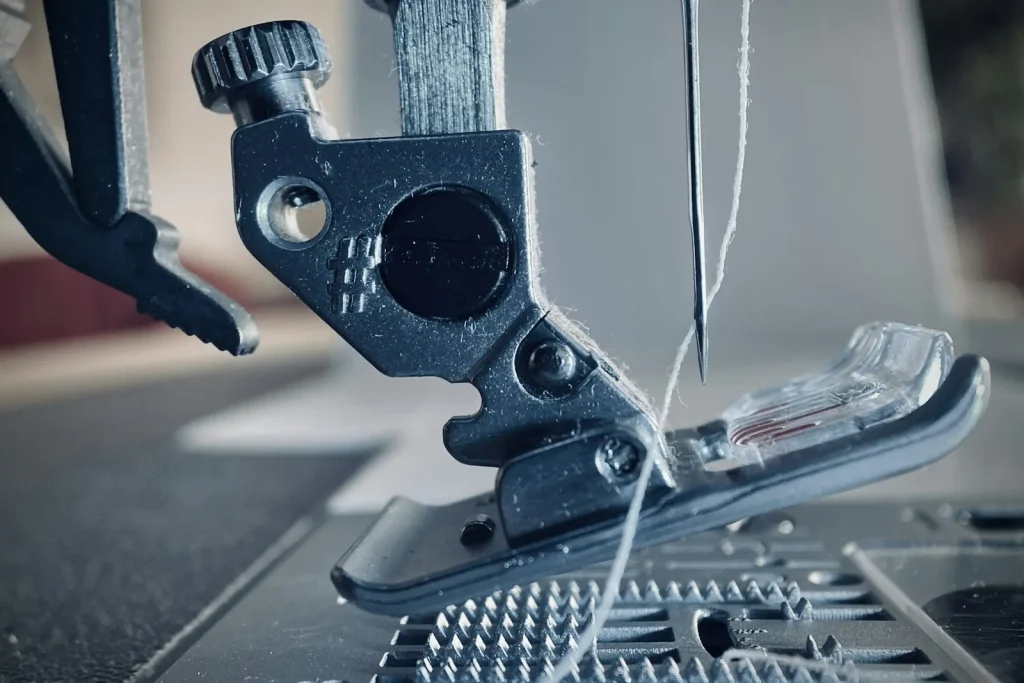
Turn the handwheel by hand until the feed dogs reach the top of their travel, the highest point in the cycle. Lay a ruler edge flat across the plate at that point and sight along it at eye level, or hold a dime flat on the plate next to a tooth and compare the tooth tip to the coin’s edge.
Dogs sitting clearly below the ruler edge or the dime’s top surface are too low. Dogs pushing the ruler up or standing visibly proud of the dime are too high. Either reading tells you which direction to adjust before you open the machine up.
The dime trick works chairside
Keep a dime in the sewing kit. It is close enough to the 1 mm target that a quick check against it, plate on, dogs at peak, catches most height problems without a single tool in hand.
Adjusting Height on a Mechanical Machine
On mechanical machines, feed dog height is set by the feed lifting rocker under the bed, the arm that pushes the dogs up and down in time with the feed cam. Most models control it with a clamp screw or an eccentric stud where the rocker meets its drive link, though the exact layout varies enough between brands and decades that checking a service diagram for your specific model before you start pays off.
Unplug the machine before you tip it back or remove the base plate, since fingers end up close to gears and linkages while you turn the handwheel by hand. The general pattern: tip the machine back or remove the base plate to reach the underside, locate the clamp screw or stud, and loosen it just enough that the rocker can rotate slightly on its shaft. With the screw loose, turn the handwheel to peak rise and adjust the rocker position until the dime test reads about 1 mm, then snug the screw back down while holding that position steady.
Recheck through a full handwheel revolution, not just the peak. Height should stay consistent through the whole cycle, and it is worth testing the drop-feed lever in both positions too, since a loose clamp can shift slightly when the lever engages and disengages the feed.
- Service diagram for your model checked before loosening anything
- Clamp screw or eccentric stud located under the bed
- Peak height set to about 1 mm with the dime test
- Screw snugged while holding position steady
- Full handwheel revolution rechecked, not just the peak
- Drop feed lever tested in both positions
Machines to Leave Alone
Know when to stop
Computerized machines with box-feed or electronic feed systems do not have a manual clamp screw to adjust, height and timing are set electronically, and opening the case risks disturbing sensors and connectors that a home fix cannot recalibrate. Anything still under warranty should go to an authorized technician regardless of machine type, since an opened case can void coverage on its own.
For everything else with a sealed feed module or a service manual that shows no accessible clamp screw, a shop visit running somewhere around $50-100 for this specific adjustment is the sensible route, especially compared with the cost of a feed module knocked further out of alignment by a guess.
Feed Timing and Centering Are Different Adjustments
Two related adjustments get confused with feed dog height often enough to name them separately. Feed timing controls when the dogs rise and fall relative to the needle’s position, not how high they rise, and it is a deeper mechanical adjustment usually left to a technician since it affects stitch formation as well as feeding.
Feed dog centering is a positioning issue rather than a height issue. Dogs that have shifted sideways in their slots rub the plate edges with every stitch, producing the scrape from the symptom table earlier and, over time, visibly worn plate slots. Centering means loosening the dogs themselves, a separate screw from the height rocker on most machines, and sliding them until they run clear of the slot edges through a full cycle, not raising or lowering them at all.
Mixing these three adjustments up wastes time. A machine with a centering problem will not improve no matter how carefully you set peak height, because the dogs were never too high or too low to begin with.
A Millimeter That Is Worth Getting Right
A machine on my bench fed weakly for years before anyone traced it back to height. A previous repair, done correctly in every other respect, had left the feed dogs sitting about 0.5 mm low, close enough to pass a casual glance but just short of gripping medium weight cotton with any confidence. The owner had spent that whole stretch increasing presser foot pressure to compensate, which masked the real cause while making fine fabric projects nearly impossible.
One adjustment of the clamp screw, maybe fifteen minutes with the base plate off, and the machine fed as well as it had the day it left the factory. Presser pressure went back to its default setting the same afternoon.
Check height with the dime test before you decide anything is wrong, adjust in small movements if you do, and recheck through a full cycle every time. Half a millimeter is a small number to chase, and it is exactly the number that separates a machine that glides through fabric from one that fights it.
Frequently asked questions
How do I know if my feed dogs are set too low?
Fabric will feed weakly or stall even when the race and slots are clean and presser foot pressure is set correctly. Check peak height with the dime test, plate on, dogs at the top of their travel, and a reading below about 0.8 mm confirms dogs sitting too low.
Can feed dog height cause my stitch length to run long?
Yes. Dogs sitting too high move fabric slightly further per stitch than the length dial calls for, and delicate fabric often shows faint track lines from the extra contact. Lowering peak height back to about 1 mm usually restores the dialed stitch length.
Is feed dog height the same adjustment as feed timing?
No, and mixing them up wastes repair time. Height controls how far the dogs rise above the plate, while timing controls when they rise and fall relative to the needle, and timing issues need a technician's tools far more often than height does.
What does it cost to have feed dog height adjusted professionally?
Budget somewhere around $50-100 at most shops for this specific adjustment on a mechanical machine, though it is often bundled into a general service visit for $75-120. Computerized machines with electronic feed systems may cost more since technicians need model specific calibration steps.
Will incorrect feed dog height damage my machine?
Dogs set too high can wear track marks into a needle plate over months of sewing delicate fabric, and dogs rubbing the slot edges from a centering problem will visibly groove the plate over time. Neither causes sudden damage, but both are worth correcting within a few sewing sessions of noticing the symptom.

Amit Sisodia
Amit Sisodia is a longtime sewing enthusiast and hobbyist repair tinkerer who has spent years diagnosing tension quirks, jammed bobbins, and stubborn feed dogs across everything from vintage treadle Singers to modern computerized machines. He writes practical, tested guides for BobbinWise so home sewists can spot problems early, tackle safe repairs themselves, and know when it's smarter to call in a technician.