Key takeaways
- A metallic or 90/14 topstitch needle with an oversized polished eye stops more snapping than any tension adjustment.
- Cutting machine speed to about a third of normal gives foil wrapped thread time to pass through the eye instead of shearing against it.
- Standing the spool upright on a thread stand removes the extra twist a horizontal spool pin adds on every rotation.
- Opening stitch length to at least 3.0mm matters most on dense satin work, where packed stitches multiply needle punctures.
- A metallic spool stored for a decade can snap constantly no matter how careful the setup, because the foil itself has aged past its working life.
Six napkins into a set of twelve, the gold metallic thread let go again. Four inches of clean stitching, then a snap, then the telltale tail poking out of the needle eye. The deadline was two days away and the fabric store was already closed for the night.
That sinking feeling is not a sign of a bad machine or clumsy hands. Metallic thread behaves differently from cotton or polyester, and the standard setup that sews perfect seams all day will shred it in minutes.
The napkins got finished that night, but only after four changes: a different needle, a lower tension number, a slower foot, and a spool turned on its side. Every one of those changes matters, and here is the full setup that keeps a spool of metallic thread running for an entire project instead of an entire evening.
What Makes Metallic Thread So Fragile
Metallic thread is not solid metal. It is a thin foil ribbon, usually a metalized polyester film, wrapped or laminated around a core thread, often polyester or nylon. That foil layer is what catches the light, and it is also what tears.
Every ordinary sewing setup is built around friction: the thread rubs through guides, through the tension discs, and through the needle eye thousands of times per minute. Cotton and polyester threads tolerate that abrasion easily. A foil wrap does not. Small rough edges inside a standard needle eye slice at the foil with every stitch until it finally lets go.
Heat adds to the damage. A needle running at full speed heats up from friction alone, and that heat softens the adhesive holding the foil to the core, so the wrap peels and catches even faster on a hot needle.
The Needle Change That Fixes Most Breaks
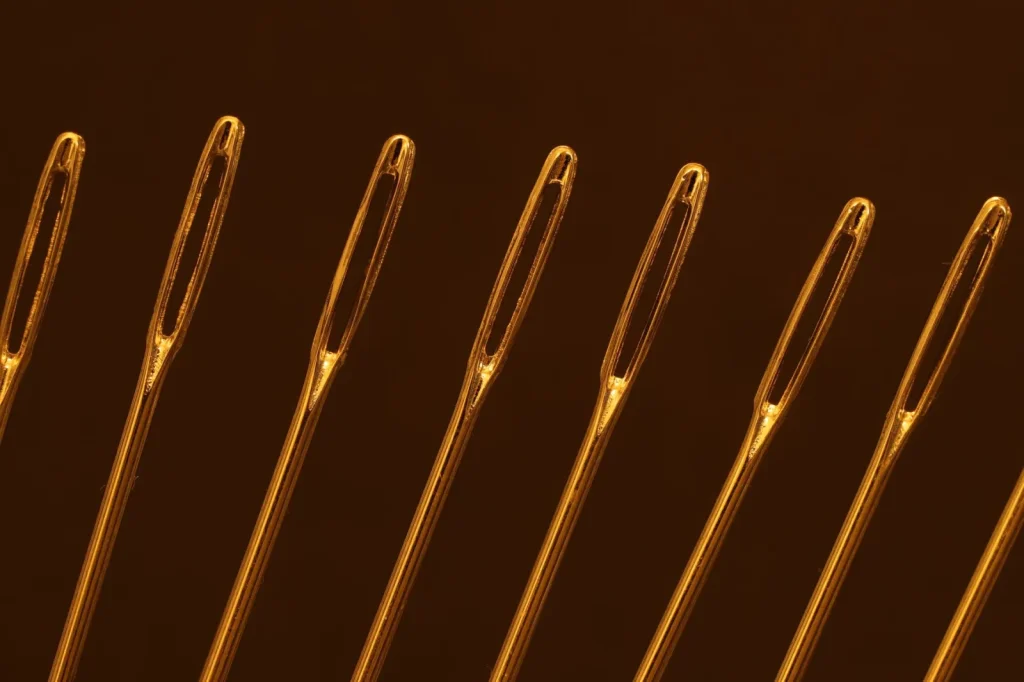
If only one change is possible, make it the needle. Swap the universal needle for a dedicated metallic needle or a 90/14 topstitch needle. Both share the feature that actually matters here: an oversized, polished eye. Change needles with the machine unplugged or the power switch off, since a stray foot on the pedal while fingers are at the clamp is how injuries happen.
A standard 80/12 universal needle has an eye sized for ordinary thread, with enough internal roughness from manufacturing to nick foil on contact. A topstitch needle’s eye is stretched longer and polished smooth specifically to let thicker or coated threads pass without friction. A dedicated metallic needle goes further, with a coated eye built for exactly this job.
This single swap solves more snapping than any tension adjustment, because it removes the point where most foil actually shears off.
Drop the Tension, Cut the Speed
With the needle sorted, turn attention to top tension. Drop it to 1 or 2 on a dial that normally runs at 4 or 5. Metallic thread has almost no stretch, so a tight tension setting that seats cotton thread neatly will instead pull a foil wrap tight enough to snap on its own.
Speed matters just as much. Cut the machine to about a third of its usual pace. A high speed needle generates more heat and more friction cycles per second, and both work directly against the foil. A slower needle stroke gives the thread time to pass through the eye instead of being dragged through it.
Watch out
Resist the urge to tighten tension when metallic thread keeps snapping. A tighter setting fights the thread harder, not less, and makes the next break arrive sooner.
Feed the Spool So It Does Not Fight the Needle
How the thread comes off the spool changes everything downstream. A horizontal spool pin spins the spool itself, and that rotation adds twist to thread that already has plenty. Extra twist catches on tension discs and needle eyes alike.
Stand the spool upright instead, either on a dedicated thread stand set behind the machine or in a deep cup beside it, and let the thread pull off the top the way it comes off a fishing reel. No spin, no added twist.
Thread stand trick
No thread stand on hand? Set the spool in a small drinking glass or a deep mug behind the machine and run the thread up past a stationary guide, like a pencil taped upright, before it reaches the machine’s first thread guide. The improvised vertical feed does the same job as a store bought stand for a project that cannot wait for shipping.
Slippery metallic spools also tend to overrun and dump loose coils onto the table, which then tangle before the thread even reaches the machine. A thread net slipped over the spool, or the classic trick of stretching a cut piece of pantyhose over it, controls the overrun without adding drag.
For a spool that has already snapped twice in one project, a single drop of silicone thread conditioner run down the length before threading buys real friction relief. It will not save badly aged thread, but on a fresh spool that keeps catching, it is often the last piece of the fix.
Give the Stitch Itself Room to Breathe
Stitch length matters more with metallic thread than with almost any other material. Set stitch length to at least 3.0mm. Shorter stitches punch the needle through the same small area of fabric over and over, and every one of those punctures is another chance to catch and shear the foil.
Dense satin stitching is the toughest environment metallic thread can be asked to survive. A tight zigzag with dozens of stitches packed into an inch multiplies needle punctures dramatically, and that is exactly where a spool that behaved perfectly on straight topstitching will suddenly start snapping every few seconds.
Tight curves taken at speed cause a similar problem: the thread has to bend sharply around the needle path while still under tension, and a fast curve gives it no time to adjust. Slow down noticeably on any curve.
Pairing the top thread with a plain, lightweight bobbin thread, 60 weight cotton or polyester, also helps. A lighter bobbin thread needs less top tension to balance against, which means less pull fighting the fragile top thread on every stitch.
Setups by Project Type
| Project | Needle | Top tension | Speed | Stitch length |
|---|---|---|---|---|
| Topstitching, edges, hems | 90/14 topstitch | 2 | About a third of max | 3.0 to 3.5mm |
| Decorative motifs, built in patterns | 80/12 metallic needle | 1 to 2 | Slowest available | Machine default, avoid dense satin settings |
| Quilting, decorative border stitching | 90/14 topstitch or metallic | 2 to 3 | Slow and steady, hand matched | 3.0mm or equivalent length |
Storage Matters as Much as Setup
Metallic thread ages, and it ages badly. The adhesive bonding foil to core dries out over years, even in a closed box, and the foil becomes brittle long before it looks any different on the spool. A spool that sat in a craft drawer for ten years may snap constantly no matter how perfect the needle, tension, and speed are, simply because the thread itself is past its working life.
Keep metallic spools out of direct sun and away from heat sources like a sunny windowsill or a garage that swings hot in summer. A sealed container or a drawer away from temperature swings adds years of usable life.
The mistake I see constantly on repair bench visits is a sewist blaming the machine for a spool that is simply too old to sew cleanly. Check the thread’s age and condition first, especially a spool inherited from a relative’s stash, before chasing tension numbers.
Even with every fix in place, metallic thread asks for more patience than cotton or polyester ever will. Sew a six inch test strip on scrap before committing to the final project, and confirm the setup holds before the good fabric goes under the needle.
That holiday napkin set finished on time, sewn at a crawl with the spool standing tall on a borrowed stand. The gold thread that had snapped every four inches ran clean for the rest of the set once the needle, tension, and speed all changed together, and the last six napkins sewed as calmly as plain cotton ever does.
Next time a spool of metallic thread goes on the machine, start with the needle change and the slower speed before touching anything else. Those two moves alone resolve most snapping, and the rest of the setup simply protects the win.
Frequently asked questions
Why does metallic thread break so much more than regular thread?
Metallic thread is a thin foil ribbon wrapped around a core, and that foil layer has almost no stretch and tears against rough surfaces. A standard needle eye and normal sewing speed generate enough friction and heat to shear the foil within a few inches, which regular cotton or polyester thread tolerates without issue.
What needle works best for metallic thread?
A dedicated metallic needle or a 90/14 topstitch needle, both built with an oversized, polished eye that lets the foil wrap pass through without catching. A standard 80/12 universal needle is the most common cause of constant snapping.
Do I need to slow my machine down for metallic thread?
Yes, cut speed to about a third of normal. High speed sewing heats the needle and multiplies friction cycles per second, both of which attack the foil layer directly. A slower, steadier pace lets the thread pass through the eye instead of being dragged through it.
Can old metallic thread be saved, or should it be thrown out?
A spool more than about ten years old, especially one stored in heat or direct sun, often has brittle foil no setup can fix. Test a six inch strip first. If it keeps snapping even with a fresh needle and low tension, retire the spool rather than fight it project after project.
Should the bobbin thread match the metallic top thread?
No, a plain lightweight bobbin thread, 60 weight cotton or polyester, works better than a matching metallic bobbin. The lighter bobbin thread needs less top tension to balance against, which reduces the pull fighting the fragile top thread on every stitch.

Amit Sisodia
Amit Sisodia is a longtime sewing enthusiast and hobbyist repair tinkerer who has spent years diagnosing tension quirks, jammed bobbins, and stubborn feed dogs across everything from vintage treadle Singers to modern computerized machines. He writes practical, tested guides for BobbinWise so home sewists can spot problems early, tackle safe repairs themselves, and know when it's smarter to call in a technician.